 USA
USA UK
UK Canada
 Australia
GMAT Preparation — Target 645+.Your MBA Starts Here.
Live online classes every Saturday with real teachers — not recorded, not AI.
4 hours/week × 12 weeks = 48 hours of expert instruction.Keep your weekdays free. Master the GMAT on Saturdays.
%20(1080%20x%201080%20px)%20(1080%20x%201080%20px).gif)

Target Score
MBA Ready.
Accepted by
7,700+ Programs
GMAT Weekend Batch Timing
1 live IST batch Mon-Sat — adaptive prep with Focus Edition
GMAT
- Mon-Sat
- Online · Zoom

I am having 50000+hours of experience in teaching students for various test preps such as GMAT,GRE and DSAT.
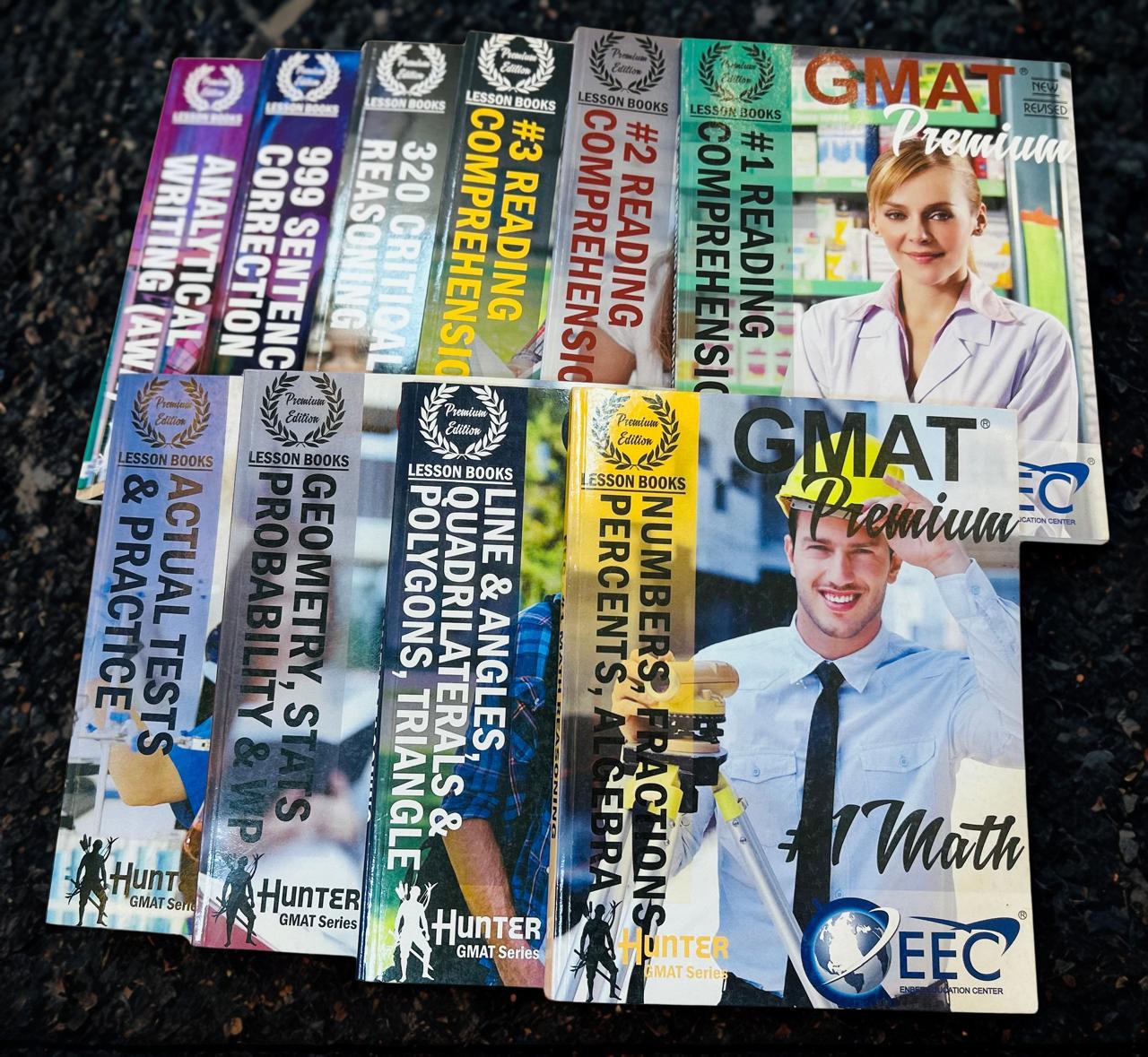
GMAT Focus Edition preparation at EEC is a 3-month live online program designed for working professionals targeting 645+ scores for top MBA programs — Harvard, Stanford, Wharton, INSEAD, ISB, and IIM PGPX. Every Saturday, join 4 hours of live interactive classes with experienced teachers via Zoom. 48 total hours of expert instruction over 12 weeks, plus 10 physical books and 6 adaptive mock tests. Accepted by 7,700+ programs at 2,400+ business schools across 110+ countries.
Why the New GMAT Favors Working Professionals
The Focus Edition was redesigned based on what business leaders actually need — not academic trivia.
Swipe GMAT advantages
3 cards2h 15m Exam — 12-Week Prep
Shorter, denser exam. Our 3-month live Saturday program gives you 48 hours of focused, teacher-led instruction — enough to master all 64 questions across 3 sections.
4 hrs/week × 12 weeksNo Grammar. No Geometry.
Sentence Correction and Geometry are gone. The Focus Edition tests Reading Comprehension, Critical Reasoning, and Algebra — skills you use at work daily.
Logic over memorizationData Insights = Your Edge
The new Data Insights section tests spreadsheet analysis, multi-source data synthesis, and chart interpretation — exactly what professionals do. Calculator included.
Real business skills testedGMAT Focus Edition — Exam Structure
3 sections, 64 questions, 2 hours 15 minutes. Choose your section order.
Swipe exam sections
3 cardsQuantitative Reasoning
Question Types
Verbal Reasoning
Question Types
Data Insights
CalculatorQuestion Types
Swipe exam controls
3 cardsChoose Section Order
Yes
Review & Change Answers
Up to 3 per section
Optional Break
10 minutes
GMAT vs GRE — Which Should You Take?
For MBA-focused professionals, the GMAT is the gold standard.
| Feature | GMAT Focus Edition | GRE General Test |
|---|---|---|
| Full Name | Graduate Management Admission Test (Focus Edition) | Graduate Record Examination (General Test) |
| Conducting Body | GMAC | ETS |
| Primary Purpose | Business school (MBA/MiM/MiF) | Graduate school (MS/MA/PhD + MBA) |
| Total Duration | 2 hours 15 minutes | 1 hour 58 minutes |
| Number of Sections | 3 | 3 |
| Section Names | Quant, Verbal, Data Insights | Quant, Verbal, Analytical Writing |
| Total Questions | 64 | 55 |
| Score Range | 205–805 | 260–340 (V+Q) |
| Score Validity | 5 years | 5 years |
| Exam Fee (India) | $324.50 (~₹27,100; $275 base + 18% GST) | ₹23,452 (flat localized) |
| Adaptive Format | Question-level adaptive | Section-level adaptive |
| Calculator | Data Insights section only | Quant section only |
| Change Answers | Yes (up to 3 per section) | Yes (within section time) |
| Choose Section Order | Yes | No |
| Essay/AWA | No (removed) | Yes (1 essay, 30 min) |
| Breaks | 1 optional 10-min break | None |
| Result Timeline | Instant unofficial; 3–5 days official | 8–10 days |
| Retake Limit | 5/year, 8 lifetime | 5/year, no lifetime limit |
| Test at Home | Yes (24/7) | Yes (24/7) |
| Accepted for MBA | All major MBA programs | Most MBA programs (growing) |
| Accepted for MS | Limited | All major MS programs |
| Best For | MBA-focused applicants, working professionals | MS/PhD + MBA flexibility |
GMAT Score to Percentile — Focus Edition
A Focus 645 = Classic 700. All scores end in '5' to distinguish from the old format.
| Focus Score | Percentile | Classic Equivalent |
|---|---|---|
| 805 | 100% | 800 |
| 755 | 100% | 800 |
| 735 | 100% | 800 |
| 715 | 99% | 770 |
| 705 | 98% | 750 |
| 695 | 97% | 740 |
| 685 | 96% | 730 |
| 665 | 93% | 710 |
| 645New "700" | 87% | 700 |
| 625 | 80% | 680 |
| 605 | 70% | 650 |
| 555 | 48% | 600 |
| 505 | 30% | 550 |
GMAT Score Requirements at Top Business Schools
Swipe business schools
12 cardsStanford GSB
USA
Median
705
Range: 665–755
Avg Exp: 5.0 years
Harvard Business School
USA
Median
685
Range: 645–735
Avg Exp: 5.0 years
Wharton (UPenn)
USA
Median
695
Range: 655–745
Avg Exp: 5.0 years
Chicago Booth
USA
Median
685
Range: 645–735
Avg Exp: 5.0 years
MIT Sloan
USA
Median
685
Range: 645–735
Avg Exp: 5.0 years
Columbia Business School
USA
Median
685
Range: 645–735
Avg Exp: 5.0 years
Kellogg (Northwestern)
USA
Median
675
Range: 635–725
Avg Exp: 5.0 years
INSEAD
France/Singapore
Median
675
Range: 615–715
Avg Exp: 6.0 years
London Business School
UK
Median
675
Range: 625–725
Avg Exp: 5.5 years
ISB Hyderabad
India
Median
675
Range: 615–735
Avg Exp: 4.1 years
IIM Ahmedabad (PGPX)
India
Median
665
Range: 625–725
Avg Exp: 8.5 years
IIM Bangalore (EPGP)
India
Median
655
Range: 615–715
Avg Exp: 7.0 years
Post-MBA Salary & Return on Investment
The median MBA salary continues to outpace inflation. Here's what the numbers look like in 2026.
Swipe salary outcomes
6 cardsManagement Consulting
Financial Services
Technology (PM/Strategy)
Healthcare / Biotech
FMCG / Consumer Goods
General Management
GMAT Score to Scholarship Potential
Swipe scholarship tiers
3 cards700+ (Focus 645+)
$20,000–$50,000
Merit scholarships at Top 25–50 schools
730+ (Focus 685+)
$50,000–$100,000
Significant aid at Top 20 schools
750+ (Focus 705+)
$100,000+ / Full Ride
Full scholarships at select programs
Employer MBA Sponsorship (2026)
Swipe sponsorships
4 cardsMcKinsey / BCG / Bain
Full Tuition + Stipend
2–3 years tenure, top performance
Return: 2 years post-MBA
Deloitte
Graduate School Assistance
2–4 years tenure, high rating
Return: Return as Sr. Consultant
Strategy& / PwC
Advisory Scholars Program
3 years tenure, selective units
Return: 2 years post-MBA
Amazon / Google / Microsoft
Tuition Reimbursement (Partial)
Relevant role, manager approval
Return: Varies by role
What You Get
Everything you need to score 645+ — for just ₹20,000
Swipe package inclusions
5 cards48 Hours Live Classes (12 Saturdays)
Every Saturday: Math (8 AM - 10 AM) + Verbal (10 AM - 12 PM). Live via Zoom with real teachers.
Worth ₹15,00010 Physical Books (FREE Delivery)
Quantitative Reasoning, Verbal Reasoning, and Data Insights guides shipped to your door in 3-5 days.
Worth ₹8,0006 Adaptive Mock Tests
Full-length GMAT Focus Edition mocks with detailed performance analysis.
Worth ₹4,0003-Month Live Program (12 Saturdays)
12 weeks of structured live Saturday classes covering all 3 GMAT Focus Edition sections.
Worth ₹6,000Free MBA Admission Counseling
Guidance on school selection, applications, essays, and scholarship strategy.
Worth Priceless🚀 START THIS WEEK
Pay now and join the next available batch
Saturday Batch: Math (8 AM - 10 AM) + Verbal (10 AM - 12 PM)
→ Next batch starts: Saturday
📦 Your books will be shipped within 24 hours!
Course completion certificate
Finish the course. Master the skill. Get your official certificate delivered straight to your inbox instantly!

EEC GMAT Course Completion Certificate
Start Your GMAT Journey This Saturday
3-month live online program — 50% off
GST Included. 10 Books delivered FREE. Mock test portal access.
Live classes every Saturday with real teachers • 4 hrs/week × 12 weeks = 48 hours

Rohit
“My name is Rohit, and I booked my IELTS exam date through EEC Nikol.brbrMy overall experience has been excellent from the very beginning. The entire IELTS booking process was smooth, quick, and hassle…”

Shweta Patel
“This institute is the best choice for TOEFL iBT prep.The trainers are highly knowledgeable and provide structured strategies for all four sections.Thanks to their rigorous practice sessions and expert…”
Already Living in USA?
Planning an MBA while working in the USA? Whether you're on an H-1B, L-1, or any other visa — our Saturday-only batch is designed for working professionals in US time zones.
EEC Live Class Timings in Your Timezone
Live online classes — Saturday only (10:00 AM–2:00 PM IST = Friday evening US time)
California / Seattle (PST)
Fri 8:30 PM – 12:30 AM
Perfect Friday evening
Denver / Phoenix (MST)
Fri 9:30 PM – 1:30 AM
Friday evening
Texas / Chicago (CST)
Fri 10:30 PM – 2:30 AM
Friday night slot
New York / New Jersey (EST)
Fri 11:30 PM – 3:30 AM
Friday night
India (IST)
Sat 10:00 AM – 2:00 PM
Saturday batch
IST Saturday morning = Friday evening in the US — perfect for working professionals. West Coast gets the best slot. All sessions recorded for weekend review.
Test Centers & Online Option
600+ Pearson VUE test centers across the USA
GMAT Online available — proctored via OnVUE platform
Home test needs: computer, webcam, mic, whiteboard, private room
Register at mba.com — USA fee $275 test centre / $300 online (India: $324.50 / $354 incl. 18% GST)
Target Scores for Top MBA Programs
735+ Focus → Stanford GSB, Harvard (median)
715+ Focus → Wharton, Booth, Kellogg, MIT Sloan
700+ Focus → Top-10 MBA programs
650+ Focus → Top-25 MBA programs
GMAT Focus: 3 sections, 64 questions, 2h 15m, score range 205–805
Career ROI & Scholarships
700+ Focus → $20K–$50K scholarships
730+ Focus → $50K–$100K scholarships
750+ Focus → Full ride possible
Post-MBA median: Consulting $190K, Finance $175K, Tech $163K
McKinsey/BCG/Bain offer full tuition + stipend sponsorship
For H-1B / L-1 Working Professionals
Saturday-only batch — Friday evening US time, no work conflict
Perfect for H-1B/L-1 visa holders planning MBA career pivot
Many employers (Deloitte, Amazon, Google) offer tuition reimbursement
Top MBA = career accelerator: average 60–120% salary uplift
12 Fridays commitment for the full 48-hour program
Important for GMAT Test-Takers in the USA
GMAT Focus Edition — Frequently Asked Questions
75+ questions answered for working professionals
The GMAT Focus Edition is the current version of the Graduate Management Admission Test, launched by GMAC in November 2023. It is a streamlined, 2-hour 15-minute exam with 3 sections — Quantitative Reasoning, Verbal Reasoning, and Data Insights — designed to evaluate your readiness for business school. It replaced the legacy GMAT (retired February 2024) and is accepted by 7,700+ programs at 2,400+ business schools worldwide. The exam is computer-adaptive at the question level, meaning each question's difficulty adjusts based on your performance.
GMAT stands for Graduate Management Admission Test. It is administered by GMAC (Graduate Management Admission Council), a global non-profit association of leading business schools. The GMAT is the most widely used exam specifically designed for admission to MBA, Master in Management, Master in Finance, and other graduate business programs globally.
The GMAT is ideal for working professionals planning to pursue an MBA (full-time, part-time, or executive), Master in Management (MiM), Master in Finance (MiF), or other graduate business programs. About 75% of GMAT test-takers are working professionals with an average of 3–5 years of work experience. If you're targeting top business schools like Harvard, Stanford, Wharton, INSEAD, ISB, or IIM PGPX programs, the GMAT is the preferred admission test.
The GMAT Focus Edition costs $275 USD (approximately ₹23,000) at a test center and $300 USD (approximately ₹25,100) for the online exam. In India, an additional 18% GST applies — making the effective test center cost around ₹27,100 and online around ₹29,600. Other fees include: rescheduling ($55–$165 depending on timing), additional score reports ($35 each), and Enhanced Score Report ($30).
The GMAT Focus Edition is 2 hours and 15 minutes of testing time, plus one optional 10-minute break — so the total appointment is about 2 hours 25 minutes. The exam has 3 sections of 45 minutes each: Quantitative Reasoning (21 questions), Verbal Reasoning (23 questions), and Data Insights (20 questions). This is significantly shorter than the old GMAT which was over 3.5 hours.
The GMAT Focus Edition has 3 sections, each 45 minutes: (1) Quantitative Reasoning — 21 Problem Solving questions on Arithmetic, Algebra, Number Properties, and Word Problems (no Geometry); (2) Verbal Reasoning — 23 questions on Reading Comprehension and Critical Reasoning (no Sentence Correction); (3) Data Insights — 20 questions on Data Sufficiency, Multi-Source Reasoning, Table Analysis, Graphics Interpretation, and Two-Part Analysis. Total: 64 questions in 2h 15m. You can choose the order of sections.
You can take the GMAT up to 5 times in any rolling 12-month period and up to 8 times in your lifetime. You must wait at least 16 calendar days between attempts. Each attempt costs the full registration fee. Most professionals achieve their target score within 2–3 attempts with proper preparation.
GMAT scores are valid for 5 years from your test date. For example, if you take the GMAT in March 2026, your scores remain valid until March 2031. This is particularly useful for working professionals who may want to explore MBA options over several years. Plan your test date to ensure scores are valid when you submit applications.
Yes, the GMAT Online is available 24/7 through Pearson OnVUE proctoring. You take the exam on your personal computer (no corporate laptops with VPN/firewall). You need a private room with a closed door, stable internet, and a webcam. You can use a physical whiteboard (up to 12×20 inches) or the on-screen digital whiteboard. The online exam is $300 ($25 more than test center) and is widely accepted for working professionals who need scheduling flexibility.
For Indian citizens taking the GMAT, a valid physical passport is mandatory. The name on your passport must exactly match your mba.com registration — even a minor difference can prevent you from testing. Carry your original passport (not a photocopy) on test day. For the online exam, a digital scan of your passport is required during check-in.
Register at mba.com — create an account, choose between test center or online delivery, select your preferred date and time (available up to 6 months in advance), and pay via credit/debit card, UPI, or net banking. Book at least 3–4 weeks in advance for preferred dates and locations. You'll receive a confirmation email with appointment details. Working professionals often choose weekend or evening slots — book early for the best availability.
The GMAT Focus Edition (launched Nov 2023) is shorter (2h 15m vs 3h 30m), has 3 sections instead of 4, and removes the AWA essay, Sentence Correction, and Geometry. Key improvements: you can choose section order, review and change up to 3 answers per section, and the scoring scale is 205–805 (vs 200–800). Data Insights replaces Integrated Reasoning as a core scored section. The old GMAT was fully retired in February 2024.
No, there is no negative marking on the GMAT Focus Edition. You should attempt every question — never leave a question unanswered. Since the GMAT is computer-adaptive, the difficulty adjusts based on your performance, so getting a hard question wrong has less impact than skipping it entirely. Always make your best guess if you're running short on time.
Yes, the GMAT Focus Edition lets you choose the order in which you take the 3 sections (Quant, Verbal, Data Insights). This is a major advantage over the GRE, which does not offer this flexibility. Most professionals start with their strongest section to build confidence and momentum. You select your preferred order before the exam begins.
Yes — the GMAT Focus Edition introduces a Bookmark & Review feature that lets you flag questions and revisit them at the end of each section. You can change up to 3 answers per section. This was not possible on the old GMAT where every answer was final. This gives you a strategic safety net for questions you were unsure about.
A good GMAT Focus Edition score depends on your target schools: 705+ (98th percentile) for M7 schools (Harvard, Stanford, Wharton); 665–695 (93rd–97th percentile) for Top 15 programs; 645 (87th percentile) for Top 25 schools — this is the new '700 benchmark'; 605 (70th percentile) for most reputable programs. For ISB, aim for 675+. Remember, a strong GMAT combined with solid work experience makes the strongest application.
For M7 schools on the GMAT Focus Edition: Stanford GSB median is 705 (range 665–755), Harvard HBS median is 685 (range 645–735), and Wharton median is 695 (range 655–745). While these are medians, scoring within the 80% range gives you a competitive application. A score of 705+ on the Focus Edition puts you in the 98th percentile and makes you competitive for any program globally.
The GMAT Focus Edition total score ranges from 205 to 805, in 10-point increments (every score ends in '5'). Each of the 3 sections (Quant, Verbal, Data Insights) is scored from 60 to 90 in 1-point increments. All three sections contribute equally (33.3% each) to your total score. This is different from the old GMAT which ranged from 200 to 800.
The GMAT uses question-level computer-adaptive technology — each question's difficulty adjusts based on your previous answers. Your section scores (60–90 each for Quant, Verbal, Data Insights) are combined with equal weight (33.3% each) to produce a total score from 205–805. The algorithm evaluates both accuracy and the difficulty of questions you answered correctly. Harder correct answers boost your score more than easier ones.
Yes — the GMAT Focus Edition offers a Score Preview feature. Immediately after completing the test, you see your unofficial total score on screen. You then choose to either accept and send the score or cancel it. If you cancel, schools will never see that score (cancelled scores are not visible to schools). You have 2 minutes to decide. You can reinstate a cancelled score later for $50.
You get 5 free GMAT score reports that you can send to business schools within 48 hours of receiving your official score. After 48 hours, each additional report costs $35. You can use the GMAC ScoreSelect feature to choose which test scores (from multiple attempts) to send — schools only see the scores you choose to share.
The Enhanced Score Report (ESR) costs $30 and provides a detailed breakdown of your performance across all question types, time management per section, and comparison against other test-takers. It shows your percentile ranking within each sub-skill and identifies specific areas of strength and weakness. The ESR is invaluable for professionals planning a retake — it pinpoints exactly where to focus your limited study time.
GMAC provides an official concordance table: Classic 800 = Focus 805, Classic 750 = Focus 705, Classic 730 = Focus 685, Classic 710 = Focus 665, Classic 700 = Focus 645, Classic 650 = Focus 605, Classic 600 = Focus 555. The key benchmark: a classic '700' is now a Focus '645.' Schools use these concordance tables to compare applicants with different score formats.
ISB Hyderabad's median GMAT Focus score for the Class of 2026 is 675 (80% range: 615–735). A safe target is 675+ to be competitive. For scholarship consideration, aim for 695+ (20+ points above median). ISB also considers your work experience (average 4.1 years), academic record, leadership potential, and essays. A 645+ score with strong work experience (5+ years) can still get you an interview.
A 645 on the GMAT Focus Edition places you at the 87th percentile — meaning you scored better than 87% of test-takers globally. This is the equivalent of the classic '700' and is considered the benchmark for competitive MBA applications. For reference: 705 = 98th percentile, 665 = 93rd percentile, 605 = 70th percentile, 555 = 48th percentile.
Yes — all business schools that accepted the classic GMAT now accept the GMAT Focus Edition. The transition was supported by GMAC concordance tables that allow schools to compare Focus scores with legacy scores. Over 7,700 programs at 2,400+ schools worldwide accept the GMAT. Some schools also accept the GRE or Executive Assessment (EA) as alternatives.
You see your unofficial total score immediately on screen after completing the exam. Official score reports — including section-wise scores and percentiles — are typically available on mba.com within 3–5 business days, though GMAC states it can take up to 20 business days in rare cases. You'll receive an email notification when your official scores are ready.
Most working professionals need 3–4 months of focused preparation, dedicating 10–15 hours per week. GMAC data suggests 120–200 hours total for a competitive score. If your Quant fundamentals are strong (common for IT/Engineering professionals), you may need 2–3 months. If starting from scratch or weak in Verbal, plan for 4–5 months. The key is consistency — even 1–2 hours daily is more effective than weekend-only cramming.
Self-study works if you're disciplined and have strong foundational skills. However, coaching is recommended if: you're targeting 645+ (87th percentile), you need structured preparation around a busy work schedule, you're weak in Verbal/CR (common for Indian professionals), or you need accountability. A structured online course provides daily live classes, strategy sessions, and mock tests — saving you the time of figuring out what to study.
A 12-week plan for working professionals: Weeks 1–4 (Foundations): Study 1.5–2 hours daily (7–9 PM or 5:30–7:30 AM), focus on Quant fundamentals + CR basics, take a diagnostic test. Weeks 5–8 (Integration): Add Data Insights practice, timed sectional drills, and Reading Comprehension. Weekends: 4–6 hours for mock tests and review. Weeks 9–12 (Execution): Weekly full-length mocks under test conditions, error log analysis, time management refinement. Total: ~150 hours.
Focus on Arithmetic and Algebra — Geometry has been removed from the Focus Edition. Master number properties (divisibility, primes, remainders), word problems (rate/work, mixtures, profit/loss), and algebraic equations. Indian professionals with engineering/IT backgrounds typically score well in Quant. Practice 15–20 questions daily, time yourself at 2 minutes per question, and review every error to identify patterns. Use the official GMAT Guide for authentic question types.
The Focus Edition Verbal section tests only Reading Comprehension and Critical Reasoning — no Sentence Correction. For RC: practice reading dense business/science passages and identifying main ideas, inferences, and author tone. For CR: learn to identify assumptions, strengthen/weaken arguments, and evaluate evidence. Read publications like The Economist or Harvard Business Review regularly — this builds the reading stamina needed for exam-day performance. This is typically the hardest section for Indian professionals.
Data Insights (DI) is the newest and most business-relevant GMAT section — 20 questions in 45 minutes. It includes Data Sufficiency (evaluating if data is sufficient to answer), Multi-Source Reasoning (synthesizing data from multiple tabs), Table Analysis (sorting/analyzing spreadsheet data), Graphics Interpretation (reading charts/graphs), and Two-Part Analysis (solving linked questions). This section has an on-screen calculator. Professionals who work with data/spreadsheets daily will find this section intuitive.
Start with official GMAC materials: GMAT Official Guide 2025–2026 (900+ real questions, $49.99), Official Guide Bundle ($109.99 includes sectional reviews), and Official Practice Exams 3–6 ($107.99). These use retired real GMAT questions, making them the most authentic practice. The Premium Collection ($299.99) includes everything. The free Official Starter Kit with 70 questions and 2 practice exams is a great starting point to assess your level.
Take 4–6 full-length mock tests before the actual GMAT. Start with the free GMAC practice tests to establish a baseline, then take 1 mock per week in the final 4–6 weeks. Always simulate real conditions: 2h 15m continuous, no phone, timed sections. After each mock, spend equal time analyzing errors — identify whether mistakes are conceptual, time-management, or careless. Your last 2 mocks should be within 2 weeks of test day.
Top mistakes: (1) Spending too long on hard questions — flag them and move on; (2) Not using all 3 answer-change opportunities per section; (3) Ignoring Data Insights preparation (it's 33% of your score); (4) Cramming on weekends instead of consistent daily practice; (5) Taking mocks without analyzing errors afterward; (6) Neglecting Verbal/CR because 'I'm good at English'; (7) Not using the on-screen calculator efficiently in DI; (8) Delaying the exam repeatedly due to 'not feeling ready.'
The GMAT and GRE test different skills. GMAT Verbal is harder for most — it focuses on logical reasoning and argument analysis rather than vocabulary. GMAT Data Insights is unique and tests data interpretation skills not found on the GRE. However, GMAT Quant is generally considered easier than GRE Quant for Indian professionals because it drops Geometry and focuses on Arithmetic and Algebra. Overall, the GMAT is more 'business-oriented' while the GRE is more 'academic.'
GMAC research suggests 120–200 hours for a competitive GMAT score. For working professionals, a realistic breakdown: 10–15 hours per week × 12–16 weeks = 120–240 hours. To improve 100 points (e.g., 525 to 625), expect 180–200 hours over 3–4 months. To improve 80 points (e.g., 625 to 705), expect 250–300+ hours over 5–6 months. Quality matters more than quantity — focused, analytical practice beats passive studying.
Both work — choose whichever suits your energy levels. Early risers (5:30–7:30 AM): Brain is fresh, fewer distractions, good for analytical sections (Quant, DI). Night owls (9–11 PM): Wind down study for Verbal/RC. The key is consistency — pick one time and stick to it for 12 weeks. Many professionals also use weekends for intensive 4–6 hour study blocks and mock tests. Some use their lunch break for 30-minute vocabulary or CR drills.
Yes — 3 months (12 weeks) is the most common preparation timeline for working professionals. You'll need 10–15 hours per week (about 1.5–2 hours daily + weekend blocks). This works best if you have a reasonable Quant foundation and can commit to consistent daily study. Use the first 4 weeks for foundations, weeks 5–8 for integrated practice, and weeks 9–12 for mocks and refinement. If targeting 665+, 3 months is tight but achievable with coaching.
Use mobile apps (GMAT Official Prep app) for on-the-go practice during travel. Pre-record your daily study targets and shift study blocks when travel disrupts your routine. During busy work seasons, reduce to maintenance mode (30–45 min daily) rather than stopping completely. Schedule your GMAT test date during a relatively calm work period. Some professionals take 3–5 days of PTO in the final week for intensive revision.
A full sabbatical is usually not necessary. Most successful GMAT takers prepare alongside their jobs. However, consider taking 3–5 days off in the final week before your test for intensive revision and mock practice. If targeting a very high score (705+), some professionals take 1–2 weeks off for the final push. Never quit your job for GMAT prep — work experience is a critical part of your MBA application, and a gap looks worse than a slightly lower score.
Choose GMAT if you're 100% targeting MBA programs — it's the gold standard and over 70% of business school applicants use it. Choose GRE if you want flexibility to apply to both MS and MBA programs. The GMAT has an edge at elite business schools because admissions committees have decades of data correlating GMAT scores with student success. For Indian working professionals targeting ISB, IIMs, or M7 schools, the GMAT is the stronger signal.
The GMAT and CAT serve different purposes. CAT (by IIMs) is for Indian MBA programs (IIM PGP, 2-year programs for fresh graduates/early career). GMAT (by GMAC) is for global MBA programs AND Indian executive programs (ISB, IIM PGPX, IIM EPGP). If you're a working professional with 4+ years experience, GMAT is usually the better choice — it opens doors to global schools AND Indian executive programs. CAT is designed more for candidates with 0–3 years experience.
Most top MBA programs now accept GRE scores alongside GMAT. However, there's a nuance — some admissions committees still view the GMAT more favorably for MBA applicants because it's specifically designed for business school readiness. About 90% of top MBA programs accept the GRE, but 70%+ of applicants still choose the GMAT. If you've already taken the GRE for an MS application and now want an MBA, check your target school's specific policy.
Officially, most schools say they have 'no preference.' In practice, GMAT applicants have historically had slightly higher admission rates at elite programs. The GMAT is designed specifically for business school, so admissions committees have stronger predictive data. For M7 and top global schools, the GMAT remains the dominant test. For ISB and IIM executive programs, GMAT is strongly preferred. If you're only applying to MBA programs, the GMAT is the safer choice.
They test different skills. CAT has a much lower acceptance rate (IIM-A accepts ~0.1% of applicants), making it extremely competitive on volume. GMAT is challenging in content — especially Verbal Reasoning and Data Insights. GMAT Quant is generally easier than CAT Quant (no Geometry, simpler calculation). GMAT Verbal is harder for most Indian test-takers. CAT is a 2-hour sprint; GMAT is a 2h 15m precision exercise. For professionals with 5+ years experience, GMAT is the more strategic choice.
The Executive Assessment (EA) is also by GMAC, designed specifically for Executive MBA (EMBA) candidates. It's shorter (40 minutes, no adaptive format, scored 100–200). Choose GMAT if you want maximum flexibility across full-time MBA, EMBA, and other business master's programs. Choose EA only if you're exclusively targeting EMBA programs that accept it. The GMAT score opens more doors and is valid for 5 years (EA is valid for 5 years too, but accepted by fewer programs).
Yes, you can take both. Some applicants take the GRE for MS applications and the GMAT for MBA applications. Schools only see the scores you choose to send (via ScoreSelect). However, taking both is expensive ($275 + $275) and time-consuming. If you're focused on MBA, just take the GMAT. If you're undecided between MS and MBA, the GRE offers more flexibility. Taking both is typically unnecessary.
For Indian working professionals targeting MBA: GMAT is the clear winner. It's accepted by all major MBA programs globally and in India (ISB, IIM PGPX/EPGP, XLRI). Indian professionals typically have strong Quant skills, and the removal of Geometry in the Focus Edition plays to this strength. The Data Insights section rewards professionals who work with data daily. For pure MS applications, the GRE is better. For MBA, go with GMAT.
It depends on the program. IIM PGP (2-year) programs use CAT exclusively. But IIM executive programs (PGPX at IIM-A, EPGP at IIM-B, MBAEx at IIM-C) require GMAT, not CAT. ISB accepts GMAT (not CAT). XLRI, MDI, and Great Lakes accept both. For global MBA programs (Harvard, INSEAD, LBS), only GMAT or GRE is accepted — CAT is not valid. So if you're a working professional targeting executive or global programs, you need the GMAT regardless of your CAT score.
Key changes: Duration reduced from 3h 30m to 2h 15m. Sections reduced from 4 to 3 (AWA essay removed). Score scale changed from 200–800 to 205–805. Sentence Correction and Geometry removed. Data Insights replaces Integrated Reasoning as a scored section. New features: choose section order, bookmark & review questions, change up to 3 answers per section. Calculator now available in Data Insights. The Focus Edition is more relevant to modern business skills.
The GMAT is required or strongly recommended by virtually all top US MBA programs. Harvard, Stanford, Wharton, MIT Sloan, Columbia, Booth, and Kellogg all require the GMAT (or GRE). Some lower-ranked programs have gone test-optional post-COVID, but top schools have largely reinstated requirements. For Indian professionals targeting US MBA programs, a strong GMAT score also strengthens your F-1 student visa application by demonstrating academic intent.
Yes — all top UK MBA programs accept the GMAT. London Business School (median Focus 675), Oxford Saïd, Cambridge Judge, Imperial College, Warwick, and Manchester all accept GMAT scores. LBS is one of the most popular choices for Indian professionals seeking a 1-year MBA in Europe. UK student visa (Tier 4) applications benefit from a strong GMAT score as evidence of academic capability.
GMAT is required or recommended by most top Canadian MBA programs: Rotman (Toronto), Ivey (Western), Schulich (York), McGill Desautels, and Queen's Smith. Canada is an attractive destination for Indian professionals due to post-graduation work permit (PGWP) pathways and PR eligibility. A GMAT score of 645+ makes you competitive for top Canadian programs, and the MBA can serve as a pathway to Canadian permanent residency.
The GMAT is accepted in 110+ countries by 7,700+ programs. Major MBA destinations include: USA (all top schools), UK (LBS, Oxford, Cambridge), Canada (Rotman, Ivey), France (INSEAD, HEC Paris), Singapore (NUS, INSEAD Asia), India (ISB, IIM PGPX/EPGP), Spain (IE, IESE, ESADE), Germany (Mannheim, ESMT), Australia (Melbourne, AGSM), Hong Kong (HKUST, HKU), UAE (LBS Dubai, INSEAD Abu Dhabi), and Japan (GLOBIS, Keio).
Yes — GMAT is the primary admission test for all major European MBA programs. INSEAD (France/Singapore, median Focus 675), HEC Paris, LBS (London), IE Business School (Madrid), IESE (Barcelona), ESADE, ESMT Berlin, IMD (Switzerland), and SDA Bocconi (Milan) all accept GMAT. European MBAs are typically 1-year programs, making them attractive for working professionals who want to minimize career interruption.
Yes — many top Indian business schools accept GMAT, especially for executive and 1-year programs: ISB Hyderabad & Mohali (PGP, median 675), IIM Ahmedabad (PGPX, for 4+ years experience), IIM Bangalore (EPGP), IIM Calcutta (MBAEx, scores must be < 3 years old), XLRI Jamshedpur, MDI Gurgaon, SP Jain, Great Lakes, NMIMS. These programs are designed for working professionals and use GMAT instead of CAT.
Yes — Singapore's top MBA programs require the GMAT: INSEAD Singapore campus (median Focus 675), NUS Business School (median Focus 655), NTU Nanyang Business School, and SMU Lee Kong Chian. Singapore is increasingly popular among Indian professionals for its proximity, English-speaking environment, and strong post-MBA career opportunities in finance and tech across Asia-Pacific.
While no country directly uses GMAT scores for visa decisions, a strong score indirectly strengthens your visa application. For US F-1 visas, a competitive GMAT score demonstrates genuine academic intent. For UK Tier 4 visas, admission to a reputable school (which requires a good GMAT) is the key factor. A high GMAT score also increases your chances of scholarship offers, which in turn makes your financial documentation stronger for visa purposes.
Yes — GMAT score is one of the strongest predictors of merit scholarship eligibility. General benchmarks: Focus 645+ ($20K–$50K at Top 25–50 schools), Focus 685+ ($50K–$100K at Top 20 schools), Focus 705+ ($100K+ or full ride at select programs). ISB offers merit scholarships to high GMAT scorers. Many European schools (INSEAD, LBS, HEC) have GMAT-linked scholarship programs. Every 10-point improvement in your GMAT can translate to thousands of dollars in scholarship money.
GMAT is accepted but not always mandatory at Australian MBA programs. Melbourne Business School, AGSM (UNSW), Monash Business School, and UQ Business School accept GMAT scores. Australia is an appealing option for Indian professionals due to post-study work visa pathways (2–4 years). A GMAT score of 605+ is generally competitive for top Australian MBA programs, though strong scores help with scholarship applications.
India has 30+ GMAT test centers across 15+ cities operated by Pearson VUE: Ahmedabad, Bangalore, Chennai, Hyderabad, Kolkata, Mumbai, New Delhi, Pune, Noida/Gurgaon, Cochin, Trivandrum, Coimbatore, Jaipur, Lucknow, and Chandigarh. You can search for available dates and centers at mba.com. The online exam option (available 24/7) is also popular for professionals in cities without nearby test centers.
Step 1: Create an account at mba.com. Step 2: Choose 'Test Center' or 'Online' delivery. Step 3: Select your preferred date, time, and location (book up to 6 months in advance). Step 4: Pay $275 (center) or $300 (online) + 18% GST in India via credit/debit card, UPI, or net banking. Step 5: Receive confirmation email with appointment details. Pro tip: Book 3–4 weeks early for weekend/evening slots — they fill up fast.
Yes, you can reschedule your GMAT: More than 60 days before: $55. 15–60 days before: $110. 1–14 days before: $165. Less than 24 hours before: No rescheduling allowed (you forfeit the fee). For the online exam, fees are slightly higher ($60, $120, $180). Working professionals should book with some buffer — the 15–60 day window is the most common rescheduling scenario when work projects interfere.
You can cancel your appointment for a partial refund: More than 60 days before: $110 refund. 15–60 days before: $80 refund. 1–14 days before: $55 refund. Less than 24 hours: No refund. Note: these are refund amounts, not cancellation fees. If you cancel your score after taking the exam (not the appointment), you can reinstate it later for $50.
Bring only your valid passport (original, not photocopy) — the name must exactly match your mba.com registration. Everything else is provided: 5 laminated scratch sheets and 2 markers. You cannot bring phones, watches, wallets, food, water, or any electronic devices into the testing room. Arrive 30 minutes early for check-in (photo, palm scan, security check). Dress comfortably — there's no dress code, but layers are recommended as testing rooms can be cold.
The GMAT Online is taken on your personal computer with a remote proctor (AI + human) monitoring via webcam. Before starting, you do a room scan showing your workspace. You can use a physical whiteboard (12×20 inches, 2 dry-erase markers) or the on-screen digital whiteboard. You cannot have a second monitor, headset, or anyone else in the room. Water is allowed in a clear container. The test content and adaptive logic are identical to the test center version. Internet drops trigger a reconnection attempt by the proctor.
You see your unofficial total score immediately on screen after completing the exam. You then have 2 minutes to decide whether to accept or cancel the score. Official score reports (with section-wise breakdowns and percentiles) are available on mba.com within 3–5 business days, though GMAC allows up to 20 business days in rare cases. You receive an email notification when official scores are ready. Score reports are sent to schools you designate.
Yes — you can take the GMAT up to 5 times within any rolling 12-month period and up to 8 times in your lifetime. You must wait at least 16 calendar days between attempts. Each attempt costs the full registration fee. With ScoreSelect, you choose which scores to send — schools only see what you share. Most successful MBA applicants take the GMAT 2–3 times. Plan your first attempt 4–6 months before application deadlines.
If you miss your GMAT appointment without rescheduling or cancelling, you forfeit the full registration fee — no refund is provided. The exam is marked as a 'no show.' This counts toward your lifetime limit of 8 attempts. To avoid this, set multiple reminders and always reschedule if you can't make it — even the last-minute rescheduling fee ($165) is cheaper than losing the full $275 + GST.
No — GMAC explicitly prohibits taking the GMAT Online on a corporate laptop. Company firewalls, VPN software, and security restrictions can block the Pearson OnVUE browser required for the exam. You must use a personal computer with at least 4–6 GB RAM and Chrome 80+ browser. Test your setup in advance using the Pearson OnVUE system check tool at home.pearsonvue.com.
Absolutely — in fact, the average MBA admit at top schools has 5 years of work experience. Stanford GSB, HBS, and Wharton all report a median of 5 years. ISB's average is 4.1 years, and IIM-A PGPX requires 4+ years (average 8.5 years). Your work experience is a strength, not a limitation. A GMAT score combined with senior professional experience creates a powerful application. Executive MBA programs specifically target professionals with 8–15+ years of experience.
Yes — several MBA formats let you work while studying: Executive MBA (EMBA) at ISB, IIM-A PGPX, INSEAD (weekend/modular format, 15–24 months), Part-Time MBA (2–3 years, evening/weekend classes), and Online/Hybrid MBA (growing rapidly at top schools). EMBA programs are specifically designed for working professionals with 8+ years experience. One-year MBA programs (ISB, INSEAD, LBS) require quitting but minimize career interruption to just 12 months.
Programs designed for working professionals: Executive MBA (ISB PGPX Weekend, IIM-A PGPX, IIM-B EPGP, IIM-C MBAEx, INSEAD EMBA, Wharton EMBA), Part-Time MBA (Chicago Booth Evening/Weekend, NYU Stern Part-time, Berkeley Haas Evening/Weekend), Online MBA (Warwick, IE Online, UNC Kenan-Flagler, Indiana Kelley). Most require GMAT scores, though some EMBA programs accept the Executive Assessment (EA) instead.
Management consulting firms (McKinsey, BCG, Bain) commonly offer full tuition + stipend sponsorship after 2–3 years of tenure. Deloitte and PwC have Graduate School Assistance programs. Amazon and tech companies offer partial tuition reimbursement. Check your company's HR policy on educational assistance, talk to colleagues who've done MBAs, and discuss with your manager. Some firms sponsor informally even without a formal policy. If your employer won't sponsor, MBA loans from banks like SBI, HDFC, and Prodigy Finance are widely available.
MBA salary uplift varies significantly by program and industry. Consulting: 60–120% increase (McKinsey/BCG/Bain offer $190K+ starting). Finance: 30–80% increase. Tech PM/Strategy: 40–80% increase. In India: ISB graduates report average CTC of ₹34 LPA, IIM PGPX/EPGP graduates report ₹30–35 LPA. The ROI recovery period for Indian programs is 18–24 months, significantly faster than the 4–6 years for US programs due to lower tuition costs.
It depends on the program. Many EMBA programs accept the GMAT, GRE, or GMAC's Executive Assessment (EA). ISB's Weekend PGPX program requires GMAT. IIM-A PGPX requires GMAT. INSEAD EMBA accepts GMAT or EA. Some programs waive the test requirement for candidates with extensive professional experience (15+ years) and strong professional credentials. If you're considering both full-time MBA and EMBA options, take the GMAT — it's accepted everywhere.
Total 2-year MBA costs: M7 schools (USA): $200K–$250K tuition + $80K–$120K living expenses + $150K–$250K opportunity cost (2 years of lost salary) = $430K–$620K total. 1-year programs (INSEAD, LBS): $100K–$130K tuition + $40K living = $140K–$170K + opportunity cost. ISB (India): ₹40–45 LPA all-in. IIM PGPX: ₹30–35 LPA. Scholarships and employer sponsorship can reduce costs by 30–100%. The ROI remains strongly positive for most graduates within 3–5 years.
There's no age limit for the GMAT or MBA. Executive MBA programs specifically target professionals aged 30–50+ with 8–15 years of experience. IIM-A PGPX average age is 32 (average 8.5 years experience). INSEAD EMBA admits candidates in their 40s regularly. For full-time 2-year MBA programs, the sweet spot is 26–32 years old. After 35, EMBA or 1-year programs (ISB, INSEAD full-time) are typically more suitable. The key metric is career impact, not age.
For working professionals with 4+ years experience, GMAT is almost always the better choice. CAT leads to IIM PGP (2-year programs designed for candidates with 0–3 years experience). GMAT opens doors to: ISB (1-year, avg 4.1 years experience), IIM PGPX/EPGP (executive, 4–15 years), and all global MBA programs. The GMAT also has the advantage of 5-year validity, flexible scheduling (year-round vs CAT's single November date), and multiple attempts.
A career break for MBA is viewed positively by employers — it shows ambition, investment in personal growth, and strategic thinking. Frame it as: 'I chose to invest in an MBA at [School] to gain [specific skills/network] that would accelerate my career in [target industry].' Top consulting firms, tech companies, and banks actively recruit from MBA programs. Your GMAT score, school brand, and internship experience during MBA matter more than the break itself.
Yes — GMAT is the primary admission test for: ISB PGP (Hyderabad & Mohali, 1-year, avg GMAT 675), IIM Ahmedabad PGPX (1-year executive, 4+ years experience required), IIM Bangalore EPGP (1-year, 5+ years experience), IIM Calcutta MBAEx (scores must be < 3 years old), and several other executive programs. These programs specifically use GMAT (not CAT) because they're designed for working professionals with significant experience.
Scholarship benchmarks on the Focus Edition: Focus 645+ (Classic 700 equivalent): Merit scholarships of $20K–$50K at Top 25–50 schools. Focus 685+ (Classic 730 equivalent): $50K–$100K at Top 20 schools; strong scholarship prospects at ISB. Focus 705+ (Classic 750 equivalent): $100K+ or full rides at select programs. Every 10-point GMAT improvement can translate to $10K–$20K in additional scholarship money. For Indian professionals, this can be the difference between an affordable MBA and an unmanageable debt burden.
Got Your GMAT Score? Now Study Abroad with EEC
EEC has helped 50,000+ students study abroad in 42 countries. Free counseling included with your GMAT enrollment.
GMAT Focus Edition Coaching — At a Glance
GMAT Focus Edition coaching at EEC costs ₹20,000 (50% off ₹40,000), designed for aspirants targeting top global business schools. The program provides 3 months of intensive live coaching plus 3 months of test simulation software. Focus areas include Data Insights, Quantitative Reasoning, and Verbal Reasoning, utilizing official GMAC question banks and adaptive test algorithms to achieve 655+ (equivalent to 710+ on the legacy GMAT).
GMAT Coaching Across 12 Cities in Gujarat
EEC offers gmat coaching at 26 branches across 12 cities in Gujarat. Choose your city:
Swipe to explore all 12 cities →
Step 1 of 3
Your contact details
We'll use these to get in touch and verify your number.
Free GMAT Masterclasses & Seminars
Live sessions from EEC's GMAT trainers and toppers. Tips, strategies, Q&A — all free.